


Bass guitar music theory is the backbone of every great bassline ever recorded, yet it remains one of the most overlooked and misunderstood subjects among players. Whether you are picking up the instrument for the first time or you have been locking grooves for years, understanding the theoretical framework behind your playing can transform you from a rhythm section player into a musical architect. This comprehensive guide dives deep into the core concepts of bass guitar music theory — from scales and intervals to chord relationships and rhythmic phrasing — giving you practical knowledge you can apply immediately on the fretboard. No fluff, no filler, just actionable insights grounded in real-world bass playing.
Why Bass Guitar Music Theory Matters More Than You Think
Many bassists fall into the trap of learning songs by rote without ever understanding why certain notes work over certain chords. Music theory for bass players is not about sitting in a classroom memorizing dusty textbooks. It is about developing an intuitive understanding of how notes, scales, and rhythms interact within a musical context. When you internalize bass guitar music theory, you gain the ability to:
- Improvise confidently over any chord progression
- Communicate effectively with other musicians using a shared language
- Compose original basslines that are both melodic and rhythmically compelling
- Adapt to unfamiliar songs by quickly identifying key signatures and chord tones
- Understand the harmonic role the bass plays within an ensemble
The truth is, the bass guitar is a bridge between rhythm and harmony. It anchors the groove while simultaneously outlining the harmonic structure of a song. Without a solid foundation in bass music theory, you are essentially navigating without a map.
Understanding the Musical Alphabet and the Bass Fretboard
Before you can dive into advanced concepts, you need a firm grasp of the basics. The musical alphabet consists of seven natural notes: A, B, C, D, E, F, and G. On the bass guitar, these notes repeat across the fretboard in a predictable pattern. Each fret represents a half step (semitone), and two half steps make up a whole step.
The Chromatic Scale on Bass
The chromatic scale includes all twelve pitches within an octave. Practicing the chromatic scale across all four strings is one of the most effective ways to map out the entire fretboard and build finger strength simultaneously. Here is how the chromatic scale looks starting from the open E string:
- E (open)
- F (1st fret)
- F# / Gb (2nd fret)
- G (3rd fret)
- G# / Ab (4th fret)
- A (5th fret)
- A# / Bb (6th fret)
- B (7th fret)
- C (8th fret)
- C# / Db (9th fret)
- D (10th fret)
- D# / Eb (11th fret)
- E (12th fret — octave repeat)
Memorizing this sequence is foundational. Every scale, every chord, and every bassline you will ever play is built from permutations of these twelve notes.
Scales Every Bass Player Should Know
Scales are the DNA of music theory. They provide the palette of notes you draw from when constructing basslines, fills, and solos. Here are the essential scales every bassist should study:

- Major Scale: The foundation of Western music. Pattern: Whole, Whole, Half, Whole, Whole, Whole, Half (W-W-H-W-W-W-H).
- Natural Minor Scale: The moody counterpart to the major scale. Pattern: W-H-W-W-H-W-W.
- Blues Scale: A six-note scale that adds the blue note (flat fifth) for a gritty, soulful sound essential to rock, funk, and blues bass playing.
- Pentatonic Scale: A five-note scale that is incredibly versatile and easy to navigate across the fretboard. Both major and minor pentatonic patterns are indispensable tools.
- Mixolydian Mode: A major scale with a flat seventh, widely used in funk, jazz, and rock basslines.
- Dorian Mode: A minor scale with a natural sixth, commonly used in jazz, funk, and neo-soul grooves.
Major vs. Minor: A Quick Comparison
| Feature | Major Scale | Natural Minor Scale | |
| Formula | W-W-H-W-W-W-H | W-H-W-W-H-W-W | |
| Sound Character | Bright, happy, uplifting | Dark, melancholic, introspective | |
| Common Genres | Pop, country, jazz | Blues, rock, metal, R&B | |
| Chord Tones Emphasized | Root, 3rd, 5th, 7th (major) | Root, flat 3rd, 5th, flat 7th | |
| Best Use for Bass | Groove anchoring in upbeat progressions | Creating tension and depth in darker progressions |
Intervals: The Building Blocks of Basslines
If scales are the DNA, then intervals are the individual letters. An interval is the distance between two notes, and understanding intervals on the bass is arguably the single most important skill for any bassist who wants to play with intention. Bass guitar music theory places intervals at the center of everything — from walking bass lines to syncopated funk grooves.
Common Intervals and Their Sound
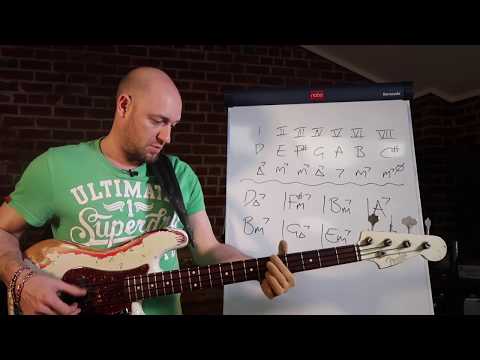
- Unison (0 semitones): Same note, same pitch. Creates stability.
- Minor 3rd (3 semitones): Adds a bluesy, emotional quality.
- Major 3rd (4 semitones): Sounds bright and resolved.
- Perfect 5th (7 semitones): Powerful and open, the most common interval in root-fifth bass patterns.
- Octave (12 semitones): Same note name, double the frequency. Creates depth and fullness.
- Minor 7th (10 semitones): Adds sophistication and a jazzy feel.

When you practice intervals, you train your ear to recognize relationships between notes instantly. This is what separates a bassist who simply plays what they see on a chart from one who truly understands the music.
Chord Theory for Bassists
Many bassists mistakenly believe chord theory is a guitarist’s concern. Nothing could be further from the truth. Understanding chords — how they are built, what notes they contain, and how they move from one to the next — gives you the harmonic context needed to craft basslines that support and enhance the music.
A basic triad is built from three notes: the root, the third, and the fifth. When you know the chord tones of the song you are playing, you can target those notes on strong beats to create a bassline that locks in with the harmony. For example, if the chord changes from C major to A minor, knowing that A minor contains the notes A, C, and E allows you to pivot smoothly into that new harmony.
Advanced bass players also study extended chords — sevenths, ninths, and elevenths — to add color and movement to their lines. Jazz bassists rely heavily on chord-scale theory, while funk and R&B players often emphasize chord tones to create melodic, vocal-like basslines that stand out in the mix.
Rhythm, Timing, and Groove in Bass Music Theory
Music theory for bass is not limited to notes and scales. Rhythmic theory is equally critical. The best basslines in history are not just about which notes are played — they are about when those notes are played. Key rhythmic concepts every bassist should master include:
- Note subdivisions: Understanding eighth notes, sixteenth notes, triplets, and syncopation allows you to create rhythmic variety within a groove.
- Ghost notes: Muted, percussive notes played between accent tones that add texture and push the groove forward.
- Rhythmic displacement: Delaying or advancing a phrase by a beat or two creates tension and unexpected movement.
- Locking with the kick drum: The bass and kick drum form the rhythmic foundation of most popular music. Learning to align and contrast with kick patterns is essential.
- Swing feel vs. straight feel: Understanding the subtle difference between even subdivisions and swung subdivisions changes the entire character of a groove.
Practical Tips to Apply Bass Guitar Music Theory Daily
Theory without application is just trivia. Here is how to make bass guitar music theory part of your daily practice routine:
- Learn one scale per week in all twelve keys using a metronome. Start slow and gradually increase tempo.
- Transcribe basslines by ear and then analyze which scales and intervals the player used.
- Play over backing tracks in different keys and genres to test your understanding of chord changes.
- Sing your basslines. If you cannot sing it, you do not truly know it.
- Study bassists known for their theoretical knowledge — players like Jaco Pastorius, Victor Wooten, and Marcus Miller all demonstrate deep harmonic and rhythmic mastery.
- Use a circle of fifths chart to visualize key relationships and chord progressions on the fretboard.
Conclusion
Bass guitar music theory is not an academic exercise — it is a practical toolkit that empowers you to play with greater intention, creativity, and musicality. From understanding the chromatic scale and mastering essential intervals to applying chord tones and rhythmic concepts in real playing situations, every concept you learn compounds your abilities as a bassist. The journey from beginner to advanced player is built on a foundation of consistent theory study paired with hands-on practice. Commit to learning the why behind the notes, and you will unlock a level of musical freedom that separates average players from truly great ones.
FAQs About Bass Guitar Music Theory
1. What is the best way for a beginner to start learning bass guitar music theory?
Start with the major scale and the natural minor scale in the open position. Learn the formula for whole and half steps, then practice finding those patterns across the fretboard. Pair this with basic interval recognition so you can hear the relationships between notes as you play them.
2. Do I need to read standard music notation to understand bass music theory?
No. While reading notation is a valuable skill, it is not a prerequisite for understanding music theory. Many world-class bassists learn theory through fretboard diagrams, ear training, and pattern-based learning. The key is understanding concepts — what a major third is, how a chord is built, and why certain scales work over certain chords.
3. How does bass music theory differ from guitar music theory?
The underlying theory is identical, but the application differs significantly. Bassists focus more on root movement, chord tones, rhythmic groove, and harmonic foundation. Guitarists tend to emphasize chord voicings, arpeggios, and melodic lead lines. For bass players, the priority is supporting the harmony while driving the rhythmic pulse.
4. Can learning bass music theory help me improve my improvisation skills?
Absolutely. Music theory gives you a framework for understanding why certain notes sound good over certain chords. When you improvise, you are not guessing — you are drawing from your knowledge of scales, intervals, and chord tones to make intentional musical choices in real time.
5. What is the fastest way to internalize bass guitar music theory on the fretboard?
Consistent daily practice with a specific focus on one concept at a time. Use a metronome, practice in all twelve keys, apply each concept to real songs, and review regularly. Active application on the instrument is far more effective than passive reading alone.
6. Is chord theory necessary for bass players who mostly play root notes?
Yes, even root-note players benefit from understanding chord theory. Knowing the chord progression allows you to choose the most effective root notes, anticipate key changes, and add targeted chromatic passing tones. Even the simplest bassline becomes more musical when you understand the harmonic context behind it.