Learning chords as a beginner can feel overwhelming, but it doesn’t have to be. Whether you picked up a guitar, keyboard, or ukulele, understanding how chords work is the single most important milestone in your musical journey. Chords form the harmonic backbone of nearly every song you’ve ever loved, and mastering even a handful of beginner chord shapes will open the door to thousands of songs across every genre. This guide breaks down everything you need to know about starting with chords, from the fundamental theory behind them to practical exercises that accelerate your progress. We’ll cover the easiest chords to learn first, common pitfalls to avoid, how to transition smoothly between chord shapes, and where to go once you’ve built a solid foundation.
What Is a Chord for Beginners? Understanding the Basics
The Building Blocks of Music
At its core, a chord is simply a group of notes played simultaneously to create a harmonic sound. For beginners, the most important thing to understand is that chords are built using intervals — specific distances between notes on a scale. The most common type of chord is a triad, which consists of three notes: a root, a third, and a fifth. For example, a C major chord contains the notes C, E, and G played together.

When someone searches for “chord beginner,” they’re usually looking for the simplest, most playable chord shapes they can start practicing right away. The good news is that you don’t need to understand music theory deeply to get started. You need to know what chord shapes look like on your instrument and how to switch between them cleanly.
The concept of open chords is especially critical for beginners. Open chords use one or more unfretted (open) strings and are generally the easiest shapes to press down and strum. They’re the go-to starting point for most music instructors and online chord tutorials because they produce full, rich sounds without requiring advanced finger strength or dexterity.
Essential Beginner Chords Every New Player Should Learn
If you’re just starting out, you want to prioritize chords that appear frequently in popular music and that are relatively easy to finger. Here’s a curated list of the most important beginner chord shapes across guitar and keyboard:
- C Major — One of the first chords taught in virtually every beginner chord lesson
- G Major — A versatile chord that pairs beautifully with C and D
- D Major — Bright and punchy, common in folk and pop
- E Major — A powerful open chord that anchors many rock songs
- A Major — Frequently used in chord progressions across genres
- Em (E Minor) — The easiest minor chord and extremely common
- Am (A Minor) — Adds emotional depth and pairs well with major chords
- F Major — A slightly harder shape that unlocks countless songs once mastered

These eight chords alone will allow you to play hundreds of songs. The G, C, and D major trio is arguably the most common group of beginner chords because they work together in countless progressions and feel comfortable under your fingers.
Open Chords vs. Barre Chords
It’s important to distinguish between open chords and barre chords early in your learning process. Open chords rely on open strings and are physically easier to play. Barre chords require you to use one finger (usually the index) to press down multiple strings across a single fret, which demands more finger strength and technique.
As a beginner, focus 100% on open chords first. Barre chords are a valuable intermediate skill, but trying to tackle them before your hand strength and dexterity are ready is one of the most common reasons beginners get frustrated and quit.
How to Practice Chords as a Beginner: A Step-by-Step Routine
Knowing how to form a chord shape is only half the battle. The real skill lies in chord transitions — moving cleanly from one shape to another without buzzing or dead notes. Here’s a structured practice routine that works for beginners:
- Learn the shape slowly. Place your fingers on the fretboard or keys one at a time. Check that each string rings clearly.
- Strum individually. Pick each string separately to identify any muted or buzzing notes before strumming the full chord.
- Practice transitions. Pick two chords and switch between them slowly, focusing on precision over speed.
- Use a metronome. Start at 40–50 BPM and switch chords every two beats. Gradually increase tempo as you improve.
- Apply it to a song. Find a simple song that uses the chords you’re practicing. Playing real music makes practice feel rewarding.
- Repeat daily. Consistency matters far more than session length. Even 10 focused minutes per day yields faster results than an occasional hour-long session.
One of the most effective beginner exercises is the G-C-D-G progression. It uses three open chords and mimics the rhythm of countless pop and country songs. Once you can switch between these three shapes smoothly, you’ve built a real foundation.
Beginner Chord Chart: The Most Important Shapes to Master
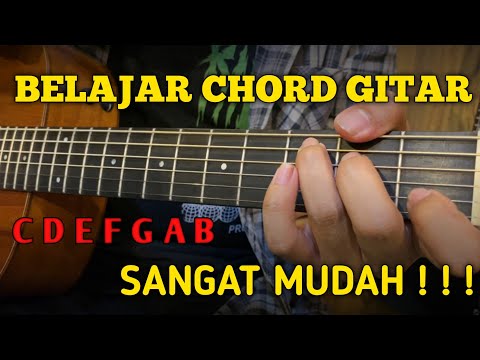
Having a visual reference makes learning chords significantly faster. The table below compares the most essential open chords for beginners, including how many fingers they require and their difficulty rating:
| Chord | Type | Fingers Used | Difficulty (1–5) | Common In |
| C Major | Major | 3 | 2 | Pop, folk, rock |
| G Major | Major | 3 | 2 | Rock, country, pop |
| D Major | Major | 3 | 2 | Folk, pop, country |
| E Major | Major | 4 | 1 | Rock, blues |
| A Major | Major | 3 | 2 | Pop, rock, blues |
| Em | Minor | 2 | 1 | All genres |
| Am | Minor | 3 | 2 | Pop, folk, rock |
| F Major | Major | 4 | 4 | Pop, rock, country |
Notice that Em and E Major rank as the easiest beginner chords, which is why they’re almost always the first chords taught in beginner chord courses. F Major, on the other hand, is a full barre shape on guitar and deserves a spot on your practice list once you’re comfortable with the easier shapes.
Common Mistakes Beginners Make When Learning Chords
Even motivated learners fall into predictable traps. Avoiding these common mistakes will save you weeks of frustration:
- Pressing too hard. You don’t need to squeeze the strings with maximum force. A firm, even touch is all that’s required.
- Ignoring thumb placement. On guitar, your thumb should sit roughly behind the neck’s midpoint. Gripping the neck too tightly limits your finger mobility.
- Practicing transitions too fast. Speed comes from accuracy, not force. Slow, deliberate practice builds muscle memory that transfers to faster playing.
- Skipping the “check” step. Always pluck each string individually after forming a chord to catch dead or buzzing notes early.
- Learning too many chords at once. Master three to four chords before adding new ones. Overloading your practice session leads to sloppy technique.
These might seem like small details, but they make an enormous difference in how quickly your chord playing improves.
Moving from Beginner to Intermediate Chord Progressions
Once you’ve mastered the eight essential open chords, it’s time to explore more dynamic chord progressions — specific sequences of chords that create a harmonic feel. The I-IV-V progression (where Roman numerals represent scale degrees) is the most foundational progression in Western music and uses chords built on the first, fourth, and fifth notes of a major scale.
For example, in the key of G, the I-IV-V progression is G-C-D. In the key of C, it becomes C-F-G. These progressions appear in thousands of songs and are the backbone of beginner to intermediate chord playing.
At the intermediate level, you’ll start incorporating seventh chords (like C7, G7, and D7), sus chords (sus2, sus4), and add chords (add9). These variations add color and sophistication to your playing without dramatically increasing difficulty.
Another important intermediate milestone is learning to read a chord chart and understand Nashville number notation, which allows musicians to communicate chord progressions across different keys without rewriting everything.
Advanced Tips: Expanding Your Chord Vocabulary
Once open chords feel natural and barre chords are no longer a struggle, you can start exploring more advanced concepts that separate casual players from serious musicians:
- Chord inversions — Playing the same chord with a different note in the bass position for smoother voice leading
- Extended chords — 9ths, 11ths, and 13ths that add jazz-influenced complexity
- Chord melody — Combining melody notes with chord voicings on guitar
- Modulation — Shifting between keys within a song using pivot chords
- Slash chords — Chords like C/G or D/F#, where a note other than the root plays in the bass
These techniques transform your playing from “chord strumming” to genuine musical expression. But they all build on the same foundation you started with as a beginner.
Frequently Asked Questions
What is the easiest chord for a beginner to learn? Em (E Minor) and C Major are widely considered the easiest beginner chords because they require minimal finger placement and produce clear, full sounds on the guitar.
How long does it take to learn beginner guitar chords? Most dedicated beginners can learn their first five open chords within two to four weeks of consistent daily practice. Full mastery with clean transitions typically takes one to three months.
Should I learn chords on guitar or piano first? Both instruments approach chords differently. Piano makes chord theory visually intuitive because notes are laid out linearly, while guitar is more portable and social. Choose the instrument that excites you most — motivation matters more than the instrument itself.
What is the best way to memorize beginner chord shapes? The most effective method is practice through application. Learn three chords at a time, immediately find a song that uses them, and play along repeatedly. Muscle memory from real playing sticks far better than rote memorization alone.
Do I need to learn music theory to play chords? No. You can become a competent chord player without any theoretical knowledge. However, understanding basic concepts like major and minor scales helps you grasp why certain chords sound good together and accelerates your ability to learn new songs.
Can I learn chords from online tutorials alone? Absolutely. There are countless high-quality free resources, interactive chord charts, and video lessons available today. The key is to combine passive learning (watching) with active practice (playing) and to record yourself periodically to track improvement.
Conclusion
Starting your chord journey as a beginner is one of the most rewarding decisions you can make as a musician. The chords you learn first — C, G, D, Em, Am, and their friends — become the vocabulary you’ll use for the rest of your musical life. Focus on clean fingering, smooth transitions, and consistent daily practice, and you’ll be playing real songs surprisingly fast. Remember that every skilled player was once a beginner struggling with their first F barre chord. The gap between where you are now and where you want to be is bridged simply by showing up and practicing. Start with the basics, stay patient with your progress, and enjoy every small victory along the way.