


Whether you are a complete beginner picking up an instrument for the first time or an experienced musician looking to deepen your understanding of how music works, Alfred Music Theory offers a structured, time-tested path to musical literacy. Alfred Music has been a trusted name in music education for decades, and their theory method stands out for its clear progression, practical approach, and wealth of supporting materials. In this comprehensive guide, we will walk through everything you need to know about the Alfred music theory curriculum — from core concepts and book levels to expert strategies that will help you get the most out of every lesson.
What Is Alfred Music Theory and Why It Matters
The Alfred Music Theory program is a comprehensive educational series designed to teach musicians the foundational and advanced principles of music. Unlike many other methods that treat theory as an abstract academic exercise, Alfred integrates theory with practical musicianship. Students learn to read notation, understand harmony, analyze chord progressions, and apply rhythmic concepts — all within a single cohesive curriculum. This approach makes it especially valuable for self-learners, classroom settings, and private instruction alike.
Understanding music theory is not just about passing exams or memorizing terms. It empowers you to communicate with other musicians more effectively, improvise with confidence, compose original music, and appreciate the architecture behind the pieces you love. The Alfred method breaks these concepts into digestible stages, ensuring that no learner gets overwhelmed.
The Alfred Music Theory Series at a Glance
The flagship product in this line is the Alfred’s Essentials of Music Theory series, which spans three complete books covering beginner through intermediate levels. Each book includes lessons, reviews, ear-training exercises, and unit tests. Alfred also publishes the Alfred Music Theory for Young Beginners series for younger students, along with companion workbooks and software tools that reinforce learning through interactive exercises.
- Book 1: Fundamentals — staff notation, whole and half notes, time signatures, basic intervals, major and minor scales
- Book 2: Intermediate concepts — major and minor keys, chords, cadences, transposition, and syncopation
- Book 3: Advanced topics — chromatic harmony, modulation, altered chords, form analysis, and introduction to jazz theory
Core Concepts Covered in Alfred Music Theory Books
The Alfred curriculum covers a broad range of topics that are essential for any well-rounded musician. Here are the key areas of study organized by category:
- Notation and Reading Music: Understanding the treble and bass clefs, note values, rests, dotting, and ledger lines
- Rhythm and Meter: Time signatures, dotted rhythms, triplets, compound meter, and syncopation
- Scales and Key Signatures: Major and minor scales, pentatonic scales, modes, and enharmonic equivalents
- Intervals: Major, minor, perfect, augmented, and diminished intervals and how they function in melodies and chords
- Chords and Harmony: Triads, seventh chords, chord inversions, dominant and diminished seventh chords
- Chord Progressions and Cadences: Authentic, half, plagal, and deceptive cadences
- Musical Form and Analysis: Binary, ternary, sonata-allegro, rondo, and blues forms
- Ear Training: Interval recognition, melodic dictation, and rhythmic dictation exercises
Beginner Level: Getting Started with Alfred Music Theory
If you are starting from scratch, the best place to begin is with Alfred’s Essentials of Music Theory, Book 1. This book assumes no prior knowledge and gently introduces every concept from the ground up. You will learn to identify notes on the staff, understand basic time signatures like 4/4 and 3/4, and build your first major scales.
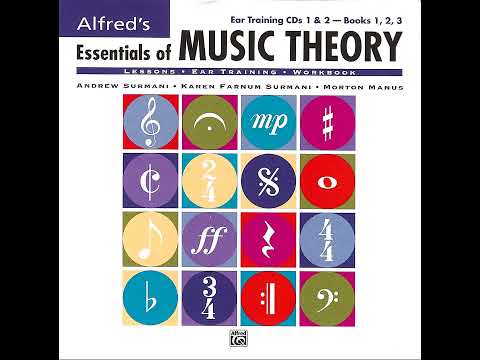
One of the strongest features of the beginner level is the inclusion of ear-training CDs (or digital equivalents in newer editions). Listening exercises reinforce what you read on the page, bridging the gap between theory and aural recognition. For younger students, the Alfred Music Theory for Young Beginners series uses colorful illustrations, simplified exercises, and a playful format that keeps children engaged while absorbing core concepts.
Expert Tip: Do not skip the review units at the end of each section. These cumulative reviews are specifically designed to consolidate your learning and identify any gaps before you move forward.
Intermediate Concepts: Building on Foundations
Book 2 of the Alfred series takes students into the world of minor keys, chord construction, and harmonic analysis. You will learn how major and minor scales relate to each other through relative keys, how to build triads and seventh chords from any scale degree, and how chord progressions create tension and resolution in music.
This level also introduces transposition — the ability to move a melody or chord progression from one key to another — which is an invaluable skill for performers and arrangers. Ear training becomes more challenging at this stage, requiring students to identify intervals, chord qualities, and rhythmic patterns by ear alone.
For piano students specifically, the Alfred Basic Piano Library theory supplementary books align perfectly with the lesson books, reinforcing concepts at exactly the right pace. This synchronization is one reason Alfred remains a top choice among piano teachers worldwide.
Advanced Music Theory: Mastery with Alfred
By the time students reach Book 3, they are tackling more sophisticated harmonic concepts such as modulation, chromatic chords, and the analysis of musical form. The Alfred advanced materials prepare students for higher-level exams and equip them with the analytical vocabulary needed to discuss and understand complex repertoire from the Classical, Romantic, and contemporary eras.
Topics at this level include:
- Chromatic mediants and borrowed chords
- Secondary dominants and secondary leading tones
- Expanded cadential patterns and deceptive resolutions
- Song form analysis: verse-chorus, twelve-bar blues, and through-composed structures
- Introduction to jazz harmony: extended chords, altered dominants, and modal interchange
While Alfred’s advanced material does not go as deeply into atonal or post-tonal theory as a university textbook, it provides an excellent bridge between intermediate harmony and more formal academic study. Students who complete all three books will have a rock-solid foundation that prepares them for further exploration in any musical direction.
Alfred Music Theory vs. Other Popular Methods
When choosing a music theory method, it helps to compare options side by side. The table below highlights how Alfred stacks up against two other widely used curricula.
| Feature | Alfred Music Theory | Berklee Music Theory | Hal Leonard Theory |
| Target Audience | All ages, beginners to intermediate | Teenagers and adults, intermediate to advanced | All ages, beginner-focused |
| Approach | Structured, spiral curriculum with ear training | Jazz and contemporary-focused, practical | Traditional, notation-first |
| Number of Levels | 3 core books plus supplemental | 2 main volumes | 6 progressive levels |
| Ear Training Included | Yes, integrated with CDs and software | Yes, but more minimal | Limited standalone |
| Best For | Self-study and classroom use | Jazz, pop, and contemporary musicians | Young beginners and general education |
| Pacing | Moderate, with frequent reviews | Fast-paced, concept-dense | Slow and steady, highly scaffolded |
Alfred’s biggest advantage is its balance of accessibility and depth. The spiral curriculum revisits key concepts at progressively higher levels, which research shows significantly improves long-term retention. For most self-learners and private studio students, Alfred provides the ideal combination of clarity, thoroughness, and engagement.
Expert Tips for Getting the Most Out of Alfred Music Theory Materials
To maximize your progress with the Alfred method, consider these practical strategies:
- Practice theory alongside your instrument. Applying what you learn in the book to actual playing dramatically improves retention and understanding.
- Use the ear-training components daily. Even five minutes of interval recognition practice can transform your aural skills within weeks.
- Do not rush through the review units. These are not filler — they are diagnostic tools that reveal exactly where your understanding is solid and where it needs reinforcement.
- Supplement with listening assignments. Listen to pieces that demonstrate the harmonic concepts you are studying. Hearing a deceptive cadence in a Beethoven sonata makes the concept real in a way that reading about it never can.
- Join a community or find a study partner. Discussing concepts with others deepens your understanding and keeps you accountable.
- Use Alfred’s online resources and software. The publisher offers interactive tools and printable worksheets that complement the physical books and add variety to your study routine.
Frequently Asked Questions
What age is Alfred Music Theory best suited for? The main Essentials of Music Theory series is ideal for teenagers and adults, while the Young Beginners series is designed for children ages 5 to 9. The pacing and visual design of each product line reflect its target audience.
Can I teach myself Alfred Music Theory without a teacher? Absolutely. Alfred’s books are specifically designed for both self-study and classroom use. The lessons are self-explanatory, the ear-training tracks provide instant feedback, and the unit tests allow you to assess your own progress. However, working with a teacher, even occasionally, can accelerate your growth significantly.
How long does it take to complete Alfred’s Essentials of Music Theory Books 1 through 3? For a dedicated student practicing 20 to 30 minutes per day, completing all three books typically takes between 12 and 18 months. Faster learners may finish sooner, while those who spend extra time on ear training and written exercises may take longer.
Does Alfred Music Theory cover jazz and contemporary harmony? Book 3 introduces foundational jazz concepts such as extended chords, modal interchange, and altered dominants. For a deeper dive into jazz theory, pairing Alfred with a dedicated jazz method like the Berklee series will give you a well-rounded education.
Are Alfred Music Theory books available digitally? Yes. Many Alfred theory products are available as e-books and interactive software, allowing you to study on tablets and computers. The digital versions often include audio playback and automated grading for additional convenience.
Is Alfred Music Theory sufficient for ABRSM or Trinity exam preparation? Alfred’s Essentials of Music Theory covers much of the same material as these exam boards, but it is not a dedicated exam prep course. For exam-specific preparation, you may want to supplement Alfred with the official theory workbooks published by ABRSM or Trinity for the particular grade you are targeting.
Conclusion
Alfred Music Theory stands as one of the most well-rounded and accessible music education programs available today. Whether you are taking your first steps into the world of music notation or pushing into advanced harmonic analysis, the Alfred series gives you the tools, structure, and support you need to succeed. The combination of clear lessons, integrated ear training, cumulative reviews, and flexible format makes it a standout choice for learners of every age and skill level. Invest the time to work through the material methodically, apply concepts at your instrument, and you will find that your entire musicianship — your playing, your listening, and your creative expression — will be transformed.