


Whether you are a complete beginner picking up a guitar for the first time or an intermediate player looking to expand your harmonic vocabulary, understanding all chords guitar encompasses is the single most transformative journey you can undertake. Guitar chords form the backbone of virtually every genre, from folk and blues to jazz, rock, and beyond. The term “all chords guitar” is broad by design, because the guitar offers an almost infinite palette of chord shapes, voicings, and extensions that can reshape the sound of any song. This comprehensive guide breaks down everything from the simplest open-position shapes to the most sophisticated jazz voicings, giving you a structured roadmap to chord mastery on the fretboard.
The Complete Guitar Chord Landscape Explained
When guitarists talk about “all chords guitar,” they are referring to the full spectrum of chord types, shapes, and positions available across the instrument. This includes open chords, barre chords, power chords, extended chords, altered chords, and much more. Each category serves a different musical purpose and belongs at a different stage of a player’s development. The beauty of the guitar is that a single chord concept can be moved up and down the neck, transposed instantly, and voiced in dozens of different ways depending on the musical context.
Understanding this landscape means recognizing that chords are not just static shapes — they are living, movable tools. A C major chord played as an open shape near the nut sounds bright and resonant, but the same chord voiced as a barre shape at the eighth fret takes on a completely different tonal character. Mastering all of these variations gives you the freedom to adapt to any song, any key, and any arrangement.
Essential Open Chords Every Beginner Must Learn
Open chords are the foundation of guitar playing. They use at least one open, unfretted string and are generally played within the first three or four frets. These shapes are forgiving on the fingers and produce full, resonant sounds that make them ideal for strumming accompaniment. Every guitarist should build fluency in these shapes before moving on to more demanding chord forms.
Major Open Chords
The major open chords form the brightest and most uplifting sounds in the guitar repertoire. Here are the essential shapes every player should memorize:
- C Major — A bright, versatile chord that appears in countless songs across genres. Finger positioning involves the first, second, and third fingers across the second, fourth, and fifth strings.
- G Major — One of the most recognizable chords on guitar, G major uses a spread-finger shape across all six strings, creating a full and powerful sound.
- D Major — Compact and punchy, D major sits near the top of the fretboard and is a favorite for acoustic rhythm playing.
- E Major — One of the easiest chords to learn, E major uses all six strings and requires only two fingers in its basic form.
- A Major — A warm, full chord that anchors many open chord progressions and works beautifully with strumming patterns.
Minor Open Chords
Minor chords introduce emotional depth and melancholy into your playing. They are formed by lowering the third note of the corresponding major chord by a half step.
- Am (A Minor) — Perhaps the most common minor chord on guitar, Am is easy to play and sounds hauntingly beautiful in fingerstyle arrangements.
- Em (E Minor) — One of the simplest shapes on the guitar, Em requires only two fingers and produces a rich, dark tone.
- Dm (D Minor) — A slightly more challenging open minor shape, Dm adds a bittersweet quality to progressions.
- Bm (B Minor) — Often played as a barre chord, Bm is one of the chords that pushes beginners toward learning barre technique.
Barre Chords: Unlocking the Entire Fretboard
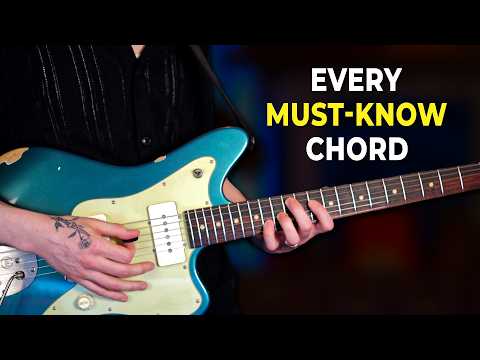
Barre chords are the gateway to playing “all chords guitar” anywhere on the neck. They use the index finger to press down multiple strings across a single fret, creating a movable shape that can be shifted up and down to produce any chord. Without barre chords, you are limited to a handful of open positions. With them, the entire fretboard opens up.
The two foundational barre chord shapes are based on the open E and open A chord shapes. The E-shape barre chord uses the same fingerings as an open E chord but with the index finger barring across the fretboard. The A-shape barre chord does the same with the open A shape. These two forms can generate every major, minor, dominant seventh, and extended chord you will ever need.
Barre chords are physically demanding at first, and many beginners struggle with muted strings and finger fatigue. The key is to use the bony side of the index finger rather than the soft pad, position the thumb behind the neck for leverage, and practice gradual pressure building. Over time, barre chords become second nature and unlock an entirely new level of fluency.
Advanced Chord Voicings and Extensions
Once you have mastered open chords and barre chords, the next step into “all chords guitar” territory involves exploring chord extensions and altered voicings. These are the shapes that separate casual players from serious musicians, adding color, tension, and sophistication to your harmonic language.
Seventh Chords and Beyond
Seventh chords add a fourth note to the basic triad, creating richer, more complex sounds. The most common types include:
- Major Seventh (Cmaj7) — Adds a dreamy, jazzy quality to progressions and is a staple of bossa nova and soft rock.
- Dominant Seventh (C7) — The workhorse of blues, funk, and gospel, creating tension that demands resolution to the tonic chord.
- Minor Seventh (Cm7) — Blends the warmth of minor tonality with a smooth, sophisticated color popular in R&B and neo-soul.
- Minor Major Seventh (CmMaj7) — An unusual and dramatic sound used in film scoring and jazz compositions.
Slash Chords and Altered Voicings
Slash chords place a bass note other than the root in the lowest voice, such as C/G or D/F#. These voicings create smooth bass movement between chords and are widely used in pop, rock, and singer-songwriter music. Altered voicings go even further, incorporating notes like sharp ninths, flat fifths, and suspended tones that add modern, sophisticated textures to your chord playing.
Comparison: Open Chords vs. Barre Chords vs. Power Chords
Understanding the differences between these three fundamental chord categories helps you prioritize your practice and choose the right tool for each musical situation.
| Feature | Open Chords | Barre Chords | Power Chords |
| Skill Level | Beginner | Intermediate to Advanced | Beginner |
| Fretboard Range | First 3–4 frets | Entire fretboard | Any position, typically lower frets |
| Sound Character | Full, resonant, open | Versatile, movable, dense | Raw, punchy, distorted-friendly |
| Strings Used | Usually 5–6 strings | Usually 5–6 strings | Typically 2–3 strings (root and fifth) |
| Common Genres | Folk, pop, country, acoustic rock | Jazz, funk, pop, rock, R&B | Rock, punk, metal, hard rock |
| Chord Types Available | Major, minor, seventh, sus | All types including extensions | Major, minor (with adjustments) |
| Difficulty | Easy | Moderate to Hard | Easy |
Expert Tips for Mastering All Guitar Chords
Learning every chord type on guitar is not about memorizing hundreds of shapes overnight. It is about building a systematic practice routine that develops muscle memory, ear training, and theoretical understanding simultaneously. Here are the strategies that experienced guitarists swear by:
- Practice chord transitions daily. The fastest way to internalize chords is to switch between two shapes repeatedly at a slow tempo, then gradually increase speed. This builds the neural pathways that make chord changes feel effortless.
- Use a metronome. Playing chords in time with a metronome develops your rhythmic precision and ensures that your chord changes land cleanly on the beat rather than rushing or dragging.
- Learn chords in families. Group chords by key — for example, practice C, Am, F, and G together — so you internalize how chords relate to each other within a harmonic context.
- Apply chords to real songs. Theoretical knowledge means little if you cannot apply it. Learn songs that use the chords you are studying, and play along with recordings to develop timing and feel.
- Focus on clean fretting technique. Press strings as close to the fretwire as possible, use the tips of your fingers, and keep your thumb centered behind the neck. Clean technique eliminates buzzing and muting problems.
- Explore chord diagrams and voicings. Use chord charts and fretboard diagrams to discover alternative voicings for familiar chords, expanding your sonic palette without learning entirely new shapes.
Frequently Asked Questions
What is the easiest way to learn all guitar chords for beginners?
The most effective approach is to start with open major and minor chords in common keys like C, G, D, and A. Practice transitioning between these shapes slowly, then gradually add barre chord forms once your hand strength and dexterity have developed. Consistency matters far more than speed — even 15 minutes of focused chord practice daily produces remarkable results over weeks and months.
How many guitar chords are there in total?
There is no fixed number because the guitar theoretically supports thousands of chord voicings when you consider every possible combination of fretted and open strings across all twelve keys. In practical terms, a well-rounded guitarist should know at least 50 to 100 essential chord shapes covering majors, minors, sevenths, and extensions, which covers the vast majority of songs encountered in popular music.
What is the fastest way to memorize guitar chord shapes?
Active recall and repetition are the fastest memorization methods. Rather than passively looking at chord diagrams, close your eyes, visualize the shape, then play it on the guitar. Repeat this cycle for each chord. Combining visual, kinesthetic, and auditory memory channels dramatically accelerates retention compared to reading charts alone.
Are barre chords harder than open chords, and how long does it take to master them?
Barre chords are objectively more difficult than open chords because they require one finger to press multiple strings across a single fret while the remaining fingers form the chord shape. Most beginners find comfortable barre chord transitions within two to six months of consistent practice, though this timeline varies significantly based on hand strength, guitar setup, and string gauge.
Which chord types are most important for playing popular songs on guitar?
The most important chord types for popular music are major, minor, dominant seventh, and sus2/sus4 chords. These four categories cover the harmonic foundation of the vast majority of pop, rock, folk, and country songs. Once you can play these chord types in open and barre positions, you will be equipped to tackle an enormous catalog of music.
Conclusion
Mastering all chords guitar is not about memorizing every possible shape — it is about building a deep, flexible understanding of how chords are constructed, voiced, and applied across the fretboard. From the simplest open major shapes to the most advanced altered jazz voicings, every chord you learn adds a new color to your musical vocabulary. Follow the structured progression outlined in this guide, practice with intention and consistency, and you will find that the entire fretboard becomes an expressive, limitless instrument. The journey of learning guitar chords is one of the most rewarding pursuits in music, and every new chord shape you add brings you closer to the freedom and creativity that only complete harmonic fluency can provide.