


Music is a universal language, and at its core lies a system of symbols and sounds that every musician must understand: all the notes of music. Whether you are a complete beginner picking up a guitar for the first time or an experienced composer orchestrating a symphony, knowing every musical note, their names, their relationships, and how they function within different scales and keys is absolutely essential. This guide breaks down every note in music — from the natural notes to the sharps and flats, from the chromatic scale to the notes written on the treble and bass clefs. We will also explore note durations, practical memorization strategies, and answer some of the most frequently asked questions about musical notes.
What Are All the Notes of Music?
When we talk about all the notes in music, we are referring to the full set of pitch sounds used in Western music theory. These notes form the building blocks of every melody, chord, and harmony you have ever heard. The Western musical system is built on twelve distinct pitches, which are organized into a framework that makes reading, writing, and performing music possible.
The foundation starts with seven natural notes: A, B, C, D, E, F, and G. These letters represent the primary tones in the musical alphabet. Everything else — the sharps, flats, and enharmonic equivalents — is derived from these seven core notes combined with accidental symbols.
The Seven Natural Notes
The seven natural notes are the simplest and most recognizable pitches in music. They are called “natural” because they do not carry any sharp or flat modifiers. On a piano keyboard, these correspond to the white keys. Here is a breakdown:
- A — The note that begins the A major scale and serves as a common tuning reference (A440).
- B — The seventh note of the C major scale and the second-to-last natural note in the musical alphabet.
- C — Often considered the starting point for beginners, C sits at the center of many scales and is the first note of the C major scale.
- D — A whole step above C and a key note in the D major scale.
- E — The final note of the C major scale before cycling back to F.
- F — A perfect fourth above C and the starting point of the F major scale.
- G — A perfect fifth above C and the anchor of the G major scale.
These seven notes repeat across the entire range of a piano, forming overlapping octaves. Each octave doubles the frequency of the previous one, giving the same note name a higher or lower pitch.
Understanding Sharps and Flats
The remaining five notes in the chromatic scale are created using accidentals: the sharp symbol (♯) and the flat symbol (♭). A sharp raises a note by a half step (the smallest interval in Western music), while a flat lowers it by a half step. For example, C♯ and D♭ are enharmonically equivalent — they sound identical on a piano but are written differently depending on the musical context.
The twelve chromatic notes are:

- A
- A♯ / B♭
- B
- C
- C♯ / D♭
- D
- D♯ / E♭
- E
- F
- F♯ / G♭
- G
- G♯ / A♭
Notice that there is no sharp or flat between B and C, or between E and F. These are the only two pairs of natural notes that are already separated by just a half step. Understanding this pattern is critical for reading scales, chords, and sheet music accurately.
The Complete Chromatic Scale
The chromatic scale includes all twelve notes listed above, played in consecutive half steps. It is one of the most important exercises for musicians because it trains your ear and your fingers to navigate every possible pitch on your instrument. Practicing the chromatic scale on piano, guitar, or any other instrument helps you internalize the full layout of musical notes and their positions.
| Chromatic Note | Half Steps from A | Enharmonic Equivalent |
| A | 0 | — |
| A♯ | 1 | B♭ |
| B | 2 | C♭ |
| C | 3 | — |
| C♯ | 4 | D♭ |
| D | 5 | — |
| D♯ | 6 | E♭ |
| E | 7 | F♭ |
| F | 8 | — |
| F♯ | 9 | G♭ |
| G | 10 | — |
| G♯ | 11 | A♭ |
| A (next octave) | 12 | — |
Notes on the Piano Keyboard
The piano is one of the best instruments for visualizing all the musical notes because its layout is linear and easy to follow. The white keys represent the seven natural notes (A through G), while the black keys represent the sharps and flats. Each black key group alternates between sets of two and sets of three, creating a repeating pattern that spans the entire keyboard.
White Keys vs Black Keys
Here is a quick comparison of the two types of keys on a standard 88-key piano:
| Feature | White Keys (Natural Notes) | Black Keys (Accidentals) |
| Total count | 52 | 36 |
| Notes represented | A, B, C, D, E, F, G | A♯/B♭, C♯/D♭, D♯/E♭, F♯/G♭, G♯/A♭ |
| Pattern | Sequential letters repeating | Groups of 2 and 3 alternating |
| Function | Natural pitch foundation | Chromatic alterations |
Finding middle C is the first milestone for most piano learners. It sits near the center of the keyboard and serves as a reference point for navigating all other notes across the instrument’s range.
Notes in Different Clefs
Sheet music uses clefs to define the pitch range of the notes written on the staff. The two most common clefs are the treble clef (used for higher-pitched instruments like the violin and right-hand piano parts) and the bass clef (used for lower-pitched instruments like the cello and left-hand piano parts).
In the treble clef, the lines from bottom to top read E, G, B, D, F, while the spaces spell out F, A, C, E. In the bass clef, the lines are G, B, D, F, A, and the spaces are A, C, E, G. Memorizing these note positions is one of the most fundamental skills for any musician learning to read notation.
Note Duration and Rhythm
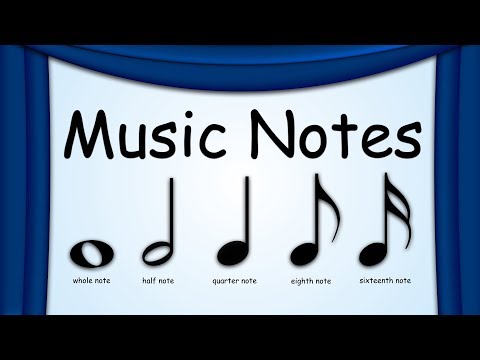
Knowing the names of notes is only half the equation. Note duration tells you how long each note sounds relative to the beat. The most common note values include:
- Whole note — lasts four beats in 4/4 time
- Half note — lasts two beats
- Quarter note — lasts one beat
- Eighth note — lasts half a beat
- Sixteenth note — lasts a quarter of a beat
Understanding how long each note sustains is just as important as knowing its pitch. Rhythm and pitch work together to create the complete musical experience, and mastering both is essential for any serious musician.

Expert Tips for Memorizing All Music Notes
Memorizing all the musical notes and their positions can feel overwhelming at first, but these expert strategies make the process faster and more effective:
- Use mnemonic devices — Create sentences from the note names on the lines and spaces of the staff. For example, “Every Good Boy Does Fine” for the treble clef lines.
- Practice the chromatic scale daily — Even five minutes of playing through all twelve notes builds muscle memory and ear training.
- Learn intervals, not just individual notes — Understanding the distance between notes (whole steps, half steps) helps you predict where the next note falls.
- Play simple songs — Applying note knowledge to real melodies reinforces recognition far better than dry memorization.
- Use flashcard apps — Digital tools like music theory flashcards provide spaced repetition that cements note identification over time.
Conclusion
All the notes of music form a coherent and logical system that opens the door to reading, writing, improvising, and composing. From the seven natural notes to the full chromatic palette of twelve pitches, understanding these fundamentals gives you the confidence to tackle any piece of music, any genre, and any instrument. The key is consistent practice, active ear training, and a willingness to explore how these notes interact within scales, chords, and progressions. With the strategies and knowledge outlined in this guide, you are well-equipped to master the complete world of musical notes and elevate your musicianship to the next level.
FAQs
What are all 12 notes in music called?
The twelve notes in music are collectively known as the chromatic scale. They consist of seven natural notes (A, B, C, D, E, F, G) and five accidental notes (A♯/B♭, C♯/D♭, D♯/E♭, F♯/G♭, and G♯/A♭). Together, these twelve pitches form the complete set of unique tones used in Western music theory.
How many musical notes are there in total?
There are twelve distinct notes in Western music theory, which make up the chromatic scale. These twelve notes repeat in cycles called octaves, where each octave doubles the frequency of the previous one. While the note names cycle through A to G, the inclusion of sharps and flats brings the total to twelve unique pitches per octave.
What is the easiest way to learn all the notes on a piano?
The easiest approach is to start with the white keys (the natural notes A through G) and practice locating them using the repeating pattern of black key groups (sets of two and three). Once you are comfortable with the natural notes, gradually introduce the black keys by learning their sharp and flat names. Consistent daily practice of scales and simple songs accelerates note recognition significantly.
What is the difference between a sharp note and a flat note?
A sharp note is raised by one half step from its natural pitch, while a flat note is lowered by one half step. For example, A♯ and B♭ are enharmonically identical — they produce the same sound — but the choice between sharp and flat depends on the musical key and context. Sharps raise pitch; flats lower it.
Which note is the most important for beginners to learn first?
Middle C is widely considered the most important starting note for beginners. It sits in the center of the piano keyboard and serves as a reference point for reading both treble and bass clef notation. Learning to locate and play Middle C gives beginners a solid foundation for exploring the surrounding notes on the staff and keyboard.